Thinking about building on raw land in Cedarpines Park? That dream can be exciting, but in the San Bernardino Mountains, a vacant lot is not automatically a ready-to-build homesite. If you want to avoid costly surprises, you need to know what really drives feasibility before you sketch plans or make an offer. Let’s walk through the practical checks that matter most so you can plan with more confidence.
What Makes a Cedarpines Park Lot Buildable?
In Cedarpines Park, the biggest question is usually not how large a cabin or home you want to build. The real question is whether the land itself can support a legal, safe, and permitted build.
San Bernardino County points owners to its zoning and setback resources and permit research tools as an early starting point. That matters because zoning, setbacks, site conditions, and parcel-specific rules can shape what is possible long before construction begins.
In practical terms, most lots need to clear five basic tests:
- Legal access
- A buildable pad or building area
- Water service or approved well potential
- Sewer connection or septic feasibility
- Fire-safe access and site design
If even one of those pieces is weak, the lot may still have value, but it may not function as a straightforward build site.
Start With Access and Slope
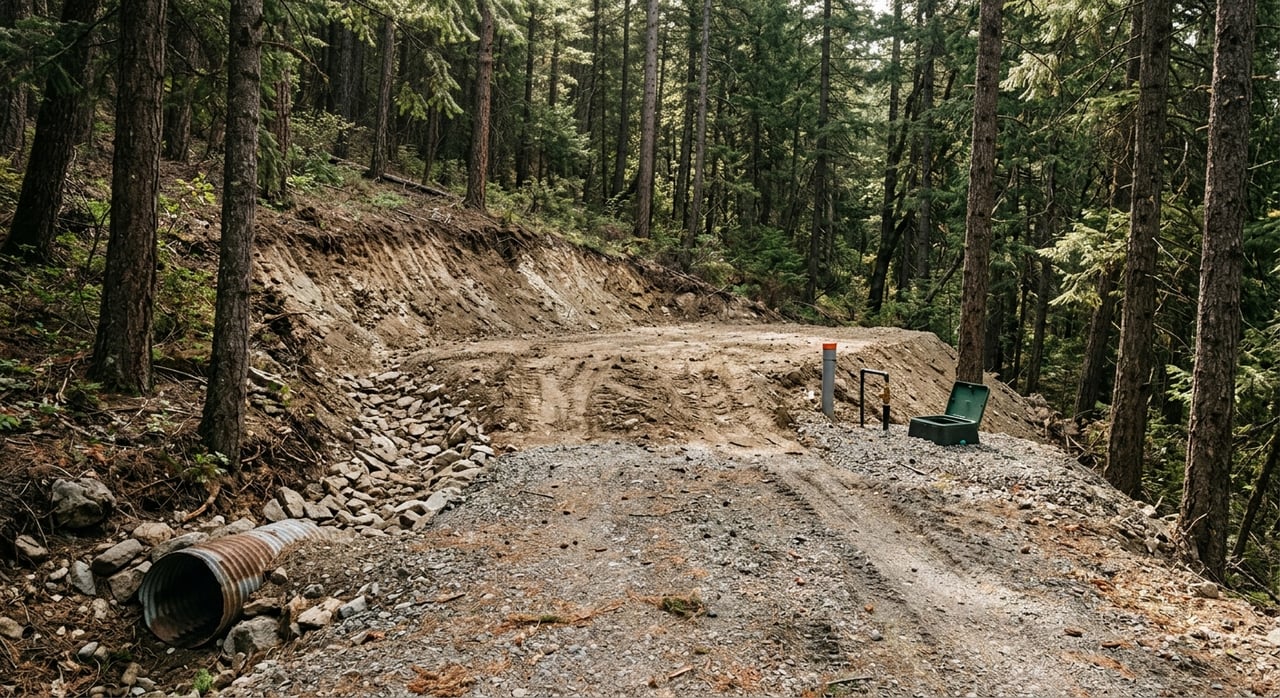
Mountain land can look usable on paper while creating major challenges on the ground. In Cedarpines Park, steep terrain often affects road design, grading, foundation planning, and fire access.
Under the county’s Fire Safety Overlay standards, access roads and perimeter roads must be able to support firefighting equipment. In general, road grades cannot exceed 12 percent, with only limited exceptions allowing 14 percent or 16 percent over short distances, and roads longer than 150 feet may require Fire Department approval, according to the county Development Code.
Slope between the road and the building area matters too. If the natural grade between the access road and the proposed building is more than 30 percent, the county may require an access road within 150 feet of the structure or an approved fire-protection system.
That is why a lot that seems affordable can become expensive fast. If access, slope, or road design do not line up, you may be looking at additional engineering, road work, or fire-related improvements before you can move forward.
Verify Water Before You Assume Anything
Water is one of the first major checkpoints for land in Cedarpines Park. You should never assume a lot works like a typical city-water parcel.
Cedarpines Park Mutual Water Company reports that its system is served by 15 groundwater wells in its service area and supplemented with purchased surface water from CLAWA, according to its Consumer Confidence Report. Just as important, the company’s rules say will-serve reports are issued only when there is membership in good standing, no delinquent balance, available service, and board approval.
That means early utility verification is critical. Before you get attached to building plans, confirm whether the parcel has access to a water purveyor, whether service is actually available, and what approvals may be needed.
If a parcel is outside a water service area, a private well may be possible if required setbacks are met and the well permit is approved. San Bernardino County Environmental Health also states that hauled water is not allowed for new construction, which makes this a very important early decision point.
Septic Can Be a Deal Maker or Deal Breaker
Wastewater is often the next major hurdle. If sewer is available, the county says a new home must connect to it. If not, the property will usually need an onsite wastewater treatment system, commonly called a septic system, according to the county’s wastewater program guidance.
Lot size matters here. The county states that all new lots must be at least one-half acre for OWTS, and projects relying on both a well and OWTS generally need 2.5 acres in areas governed by the county’s LAMP program.
For mountain parcels, percolation testing is often part of the feasibility process. The county’s percolation testing standards note that a PERC report is required for steep or otherwise critical single lots, for new OWTS in mountain areas, and for certain new-construction cases before a building permit can be issued.
In plain terms, a lot can look perfect online and still fail because the soil, slope, or site conditions do not support septic approval. That is one reason mountain land needs careful due diligence.
Know the Permit Triggers Early
Permits in mountain communities are often broader than buyers expect. In San Bernardino County, new buildings over 120 square feet require a permit, and grading of 100 cubic yards or more also needs a permit.
Retaining walls and erosion control can trigger permits too. The county materials include some inconsistency on retaining-wall thresholds, with one page listing walls over 4 feet and another FAQ listing walls over 3 feet, so it is smart to verify the current standard with Building & Safety before designing that part of the project.
If you are considering a manufactured home or another factory-built option, that may be possible on some residential parcels. But the county still requires a building permit before setup, and it states that no site work, including removing trees or plants, can begin until the proper permits are in place, as explained on the manufactured and mobilehome permitting page.
Expect Geotechnical and Erosion Review
On sloped mountain land, soil and drainage are not small details. They can influence everything from foundation design to grading costs and long-term stability.
County project materials say a geotechnical investigation may need to evaluate soil classification, site geology, slope stability, soil strength, moisture effects, load-bearing conditions, compressibility, liquefaction, and expansiveness, as needed, with results incorporated into the design. That level of review can be especially important on parcels with significant slope or uncertain soils.
Erosion control also has to be handled in the right sequence. County guidance says erosion control measures must be in place before grading or building permits are issued when the land will be disturbed, and final sign-off can require multiple county clearances.
Road Work Adds Cost and Time
A parcel may technically be buildable and still require more site work than expected. If trenching, boring, drainage work, or road improvements affect county-maintained road right-of-way, you may need permits through Public Works.
San Bernardino County Public Works states that excavation permits are required for trenching or boring in county road right-of-way, while road construction permits apply to road, drainage, and related improvements in maintained right-of-way.
This is where mountain projects often separate into two categories. Some lots are relatively straightforward. Others need enough access or utility work that the land should be evaluated as a full project, not just a simple home site.
What Timeline Should You Expect?
There is no one-size-fits-all timeline for a new build in Cedarpines Park. The schedule depends on access, water, septic feasibility, slope conditions, grading needs, fire review, and how complete your plans are.
A relatively simple lot that already has workable access and utility options may move from due diligence to permit in several months. A steeper or utility-limited parcel can take a year or more before vertical construction really begins, based on the county’s separate review steps for access, water, septic, grading, fire, and inspections.
County timing rules matter too. Plan review applications can become void if no permit is issued within 180 days, and building permits expire if work does not start within 12 months, though written extensions may be granted, according to the county’s extension request form.
Inspections can also affect the pace. The county says inspection requests received by 4:00 p.m. are generally scheduled for the next work day, though some remote areas may have limited inspection availability, as noted in the county’s inspection FAQ.
Fire Readiness Is Part of Ownership
In Cedarpines Park, wildfire readiness is not just a box to check during the permit phase. It is an ongoing part of owning and improving mountain property.
San Bernardino County has announced annual defensible-space inspections in mountain communities, including Cedarpines Park. That is a good reminder that access, vegetation management, and fire-safe site planning are not only about initial approval. They are part of long-term property stewardship.
For buyers and landowners, this means the best building plans are practical plans. They account for access, defensible space, ongoing maintenance, and the realities of mountain construction from the beginning.
Hold, Build, or Sell?
If you already own land in Cedarpines Park, the smartest next step is often a feasibility review, not a rush to list or build. A parcel that clears access, water, septic, pad, and fire-design hurdles may be worth taking through the next stage. A parcel with one or two major red flags may call for a different strategy.
Sometimes the best move is to hold the lot until conditions improve or more information is gathered. Sometimes it makes sense to sell the parcel as-is and price it honestly as a project site rather than a fully ready homesite.
That kind of practical decision-making is especially important in mountain communities. Here, the feasibility questions are often the deal itself.
If you are weighing whether to build, hold, or sell land in Cedarpines Park, working with a local mountain brokerage can help you approach the process in the right order. Rosemarie Labadie and the Crestline Real Estate team bring hands-on local knowledge of mountain access, sloped lots, and practical next steps so you can make a clearer decision with fewer surprises.
FAQs
What should you check first before building on Cedarpines Park land?
- Start with zoning, legal access, slope, water availability, wastewater options, and fire-safe access requirements before spending money on design.
Does every Cedarpines Park lot have water service?
- No. You should verify whether the parcel is served by a water purveyor, whether service is available, and what approvals are required before assuming the lot can be built on.
Can you build with a septic system on Cedarpines Park land?
- Possibly, but it depends on whether sewer is available, lot size, site conditions, and whether the parcel can meet county onsite wastewater requirements, including percolation testing when required.
How long does it take to get permits for a Cedarpines Park build?
- Timelines vary widely. A simpler lot may move in several months, while a steeper or utility-limited parcel can take a year or more before construction starts.
Is hauled water allowed for new construction in Cedarpines Park?
- No. County Environmental Health states that hauled water is not allowed for new construction.
Should you build, hold, or sell a Cedarpines Park lot?
- That depends on whether the parcel can realistically clear the key tests for access, water, septic, buildable area, and fire-safe design. A feasibility review can help you decide the most practical path.