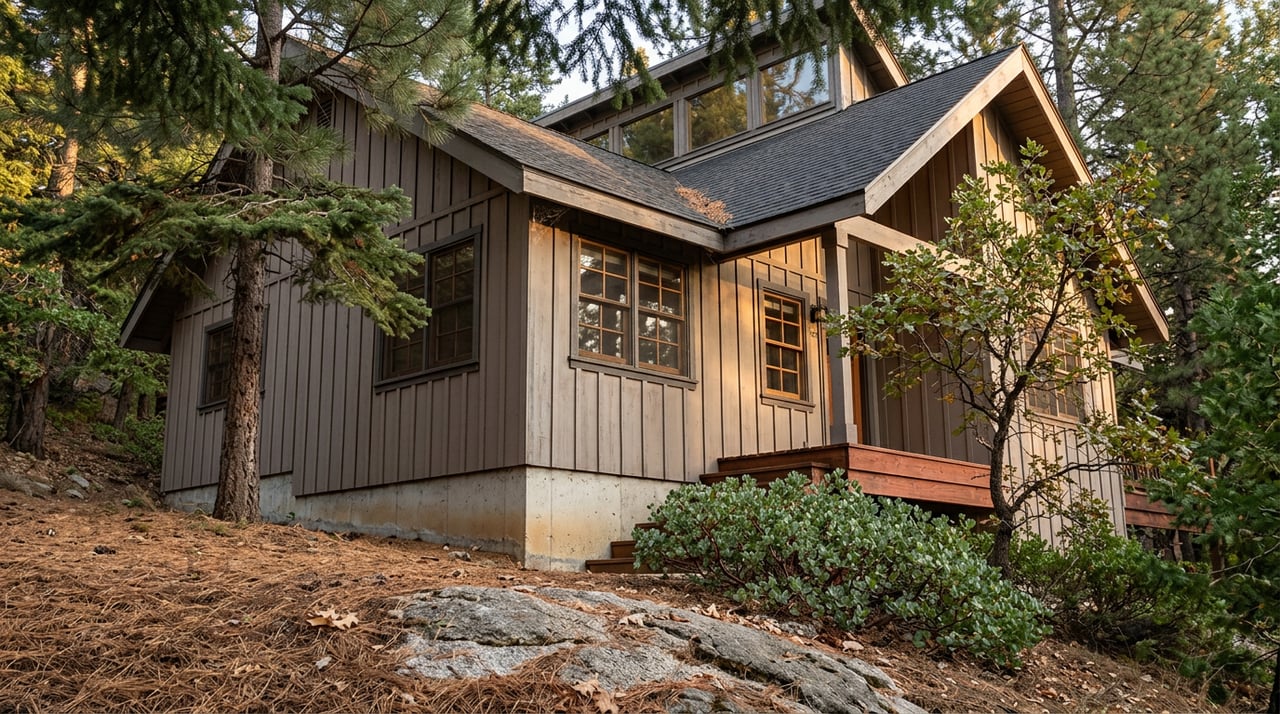
Ask a Cedarpines Park seller what conveys with the house and you'll hear the usual list: the propane tank, the woodstove, maybe the shed. Ask what a water stock certificate is doing in the escrow file, and most sellers pause. Many have owned the house for twenty years and never once thought about what "water service" actually means here, because nobody ever made them think about it. The water simply came on when they turned the tap.
That's the piece worth understanding before you write an offer in this particular pocket of the mountain. A house in Cedarpines Park doesn't just come with a water connection. It comes with a small ownership stake in the company that supplies it, and that stake behaves nothing like a utility account a mile down the road in Crestline proper.
Understanding the Water Certificate
Water here is delivered by the Cedarpines Park Mutual Water Company, a nonprofit corporation formed on January 2, 1923, to sell water at cost to its own shareholders rather than to customers in the conventional sense. When you buy a home inside its service area, you don't sign up for water the way you'd set up an account with a city utility. You become a shareholder in the company that owns the pipes, the wells, and the storage.
This isn't a marketing distinction. It changes what's actually transferring at closing. A conventional water utility bills whoever lives at the address. A mutual water company issues shares tied to the land itself, and California's framework for these companies treats that stock as running with the property. The language the state legislature used when it cleaned up mutual water company governance rules describes the mechanism plainly: when real property changes hands through sale or foreclosure, the shares tied to that property transfer along with it.
That's a meaningfully different arrangement than most buyers expect walking into a mountain purchase. It also means the paperwork trail looks a little different. Ask your escrow officer whether the preliminary title report references appurtenant water stock, and ask Cedarpines Park Mutual Water directly how they handle the certificate transfer for your specific parcel. The cleanest way to avoid a surprise after close is to ask before you're under contract, not after.
A Century-Old Company, Still Running the Same Way
The company's own language, filed in its public records, describes its mission as providing potable water to its members, not its customers. It still operates as a 501(c)(12) nonprofit, a designation the IRS reserves for mutually beneficial organizations like irrigation companies and rural utilities that exist to serve their own shareholder base rather than turn a profit for outside investors.
That structure shows up in small, telling ways. The company doesn't maintain a large administrative office of its own. Its annual shareholder meeting in 2024 was held not at a corporate headquarters but at the Crestline Sanitation District building on Lake Drive, a building that belongs to an entirely separate agency handling sewer service for the broader area. Shareholders and customers alike were welcomed at that meeting, which tells you something about scale: this is a community-run water system, governed by the people who drink from it, not a distant utility with a call center.
The Second Line on the Tax Bill
Water isn't the only thing organized differently in Cedarpines Park. The roads are handled through a completely separate mechanism: County Service Area 18, established by the San Bernardino County Board of Supervisors on July 17, 1967, to maintain 17.03 miles of paved and dirt roadways, one community center, and a five-acre park.
CSA 18 funds itself two ways. It draws a share of ordinary property tax revenue, and County Service Area 18 levies a flat $50 per parcel service charge across roughly 3,781 parcels in the district. That fee shows up on the annual county tax bill, not on a water statement, which means a buyer scanning utility costs in isolation can miss it entirely. It's a small number on its own, but it's one more line item that a buyer comparing Cedarpines Park against a neighboring community needs to actually locate and read, because it won't appear on a listing sheet.
One Highway Away, a Different Contract
Drive a few minutes toward Crestline proper and the entire arrangement changes. Water there is largely handled by the Crestline-Lake Arrowhead Water Agency, founded in 1961 to serve a much larger footprint, roughly 50,000 acres, drawing its supply from Silverwood Lake. That's a conventional public agency relationship: you pay for water as a customer, full stop. No shares, no shareholder meetings, no certificate to track through escrow.
Neither model is better on its face. A mutual water company gives residents direct governance over their own system. A larger public agency spreads infrastructure costs across a bigger customer base and tends to have more institutional capacity for major capital projects. What matters for a buyer is knowing which model applies to the specific parcel you're considering, because the answer changes depending on which side of an invisible service boundary the house sits on, and that boundary doesn't track neatly with neighborhood names on a map.
What to Confirm Before You Write an Offer
A few questions are worth asking directly, before an offer goes in rather than after it's accepted:
- Ask the seller or listing agent to confirm which water provider serves the specific parcel, not just the general area, since service boundaries can be granular.
- Ask Cedarpines Park Mutual Water Company how many shares are attached to the property and how the transfer is documented at closing.
- Pull the most recent county tax bill and confirm whether the CSA 18 parcel charge appears on it, and at what amount.
- Ask whether the property has ever had a lapse in water service tied to a shareholder dispute or unpaid assessment.
None of this is complicated once you know to ask. The problem is that almost nobody walks into a mountain purchase expecting the water bill to come with a shareholder vote attached. In a market where the median price and the square footage get all the attention, this is the kind of detail that actually determines how smoothly your escrow closes and how much control you'll have over your water costs five years down the road.
If you're weighing a purchase in Cedarpines Park against a home in Crestline, Twin Peaks, or another mountain community, the water and road structure is exactly the kind of local detail that doesn't show up on a portal listing but shapes the ownership experience for years afterward. Crestline Real Estate has spent years walking buyers through exactly this kind of parcel-specific homework before an offer goes in. Schedule a free home consultation with our local mountain experts and we'll help you read the fine print before it becomes your problem.
This article is general information, not legal, tax or financial advice. Consult a qualified professional about your situation.